
Skip to content Call Us: (918) 742-8775

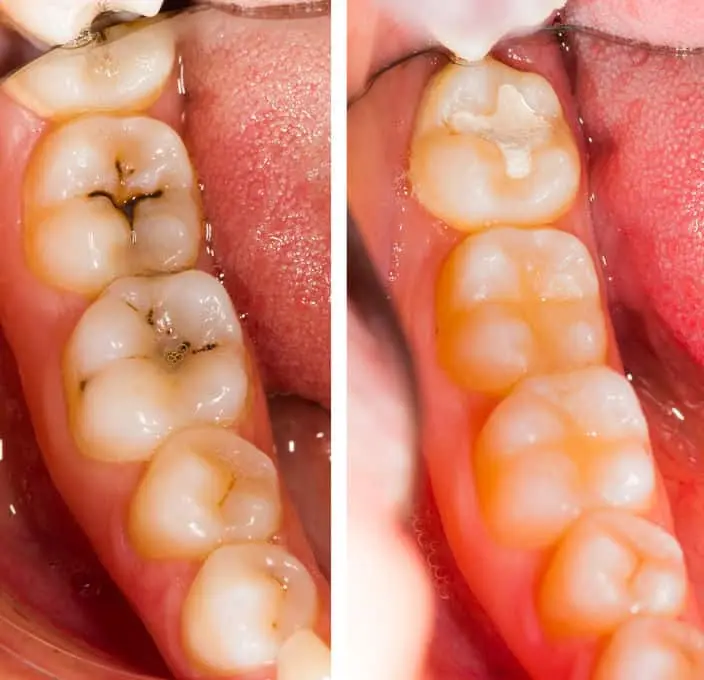
A filling repairs a tooth that has a cavity or a small chip or crack. At McDougall DDS in Midtown Tulsa, Dr. McDougall and Dr. Reed place tooth-colored composite fillings. Composite bonds to the tooth instead of depending on its shape to stay in place, so less healthy tooth needs to be drilled away to hold it.

How Cavities Start

Bacteria in plaque feed on sugar and give off acid. That acid pulls minerals out of your enamel. Between meals, saliva washes the acid away and puts some of those minerals back.

A cavity forms when that balance tips the wrong way too often. That's why how often you have sugar matters more than how much: a dessert eaten in ten minutes is one acid attack, but a sweet drink sipped all afternoon keeps the attack going for hours.

At the very first stage, before there's a hole, the damage can often be turned around with fluoride and better cleaning. Once the surface breaks down, it can't repair itself and needs a filling.

A composite filling being shaped
A dentist working on a reclined patient with a handpiece

Why Early Cavity Care Matters

A cavity doesn’t stay the same size. Enamel is hard, so decay works through it slowly, but once it reaches the softer layer underneath (the dentin) it spreads much faster.

The pattern is easy to predict. A small cavity means a small filling. A bigger one means a larger filling that weakens the tooth. Bigger still, and the tooth needs a crown. If decay reaches the nerve, it becomes a root canal, and if infection goes further, the tooth may need to come out and be replaced.

Caught at the right time, the same tooth needs the simplest and least costly repair. That’s the reason behind regular six-month checkups.

What Happens at Your Filling Visit

First, we numb the tooth. Your dentist removes the decay, which is softer than healthy tooth, and shapes what remains. The area is kept dry, because composite doesn’t bond well to a wet surface.

The composite goes on as a soft paste and is built up in thin layers, with a curing light hardening each one. The shade is matched to your tooth. Once it’s built up, it’s shaped to follow the natural contours of the tooth, and we check your bite by having you tap and slide your teeth together, adjusting until it feels normal.

Most single fillings take less than an hour, and composite is hard as soon as it’s cured, so you don’t have to wait to eat. The numbness lasts a couple of hours, so be careful not to bite your cheek or tongue until it fades.

Tooth-Colored vs. Silver Fillings

Composite is our filling material. It matches your tooth, bonds to it so less tooth has to be removed, and doesn’t need extra grooves cut into the tooth to hold it in.

Amalgam, the silver material many people received as kids, is durable and was the standard for decades. If your silver fillings are still in good condition, there’s usually no reason to replace them, since doing so removes more tooth with no health benefit. When one cracks, leaks or has decay under it, that’s a good time to switch to a tooth-colored material. Learn more on our metal-free dentistry page.

When a Filling Isn't Enough

A filling can only replace so much of a tooth. When a filling gets very large, it can work like a wedge, and the remaining walls of the tooth become more likely to split.

At that point a crown is usually the better choice, because it holds the tooth together instead of pressing it apart. Your dentist will tell you when a tooth has reached that stage rather than placing a filling that's likely to fail.

Making Fillings Last

Most fillings fail at the edge, where filling meets tooth, because that seam is where new decay starts. Clean between your teeth every day, since the spots where teeth touch are exactly where a toothbrush can't reach.

If you grind your teeth, a night guard protects your fillings along with your natural enamel. Call (918) 742-8775 or use our contact form.

Get It Checked Before It Grows

A cavity caught early means a small filling. Left alone, it can grow into a crown or a root canal.